Recapping The Biggest In-Person Canton Network Hackathon of 2026
.avif)
.avif)


On Saturday August 29th, from 10am to 10pm, the largest in-person Canton Network Hackathon of the year took over 83 Rivington Street, in the fashionable Shoreditch area of London.
The event was hosted by Cantor8, the Canton Network ecosystem’s leading infrastructure provider, with the mission of introducing Canton’s Daml smart contract language to some of the world’s best young developer talent.
83 Rivington was filled with high caliber builders and researchers from tier-one UK universities like Oxford and Cambridge, as well as talent from overseas. In total, the event saw nearly 100 individual participants break off into 20+ separate teams, each choosing one of three pre-determined hackathon tracks.

Tier One Talent Meets Institutional Finance
The hackathon was driven by Cantor8’s robust university ecosystem, which includes partnerships with blockchain organisations at Cambridge University, Oxford University, and Imperial College London.
The purpose of the event itself was to introduce promising young developers and researchers to building on Canton Network - the blockchain purpose-built to accommodate institutional finance.
While the likes of Oxford and Cambridge certainly made a strong showing, participants hailed from well beyond the United Kingdom, with high numbers of competitors flying in from France, Italy, The United States, and beyond, for the sole purpose of entering the event.
Three Tracks, All Canton
The hackathon’s assigned tasks were highly technical in nature, in stark contrast to many other blockchain hackathons which focus largely on consumer applications and attractive UI.
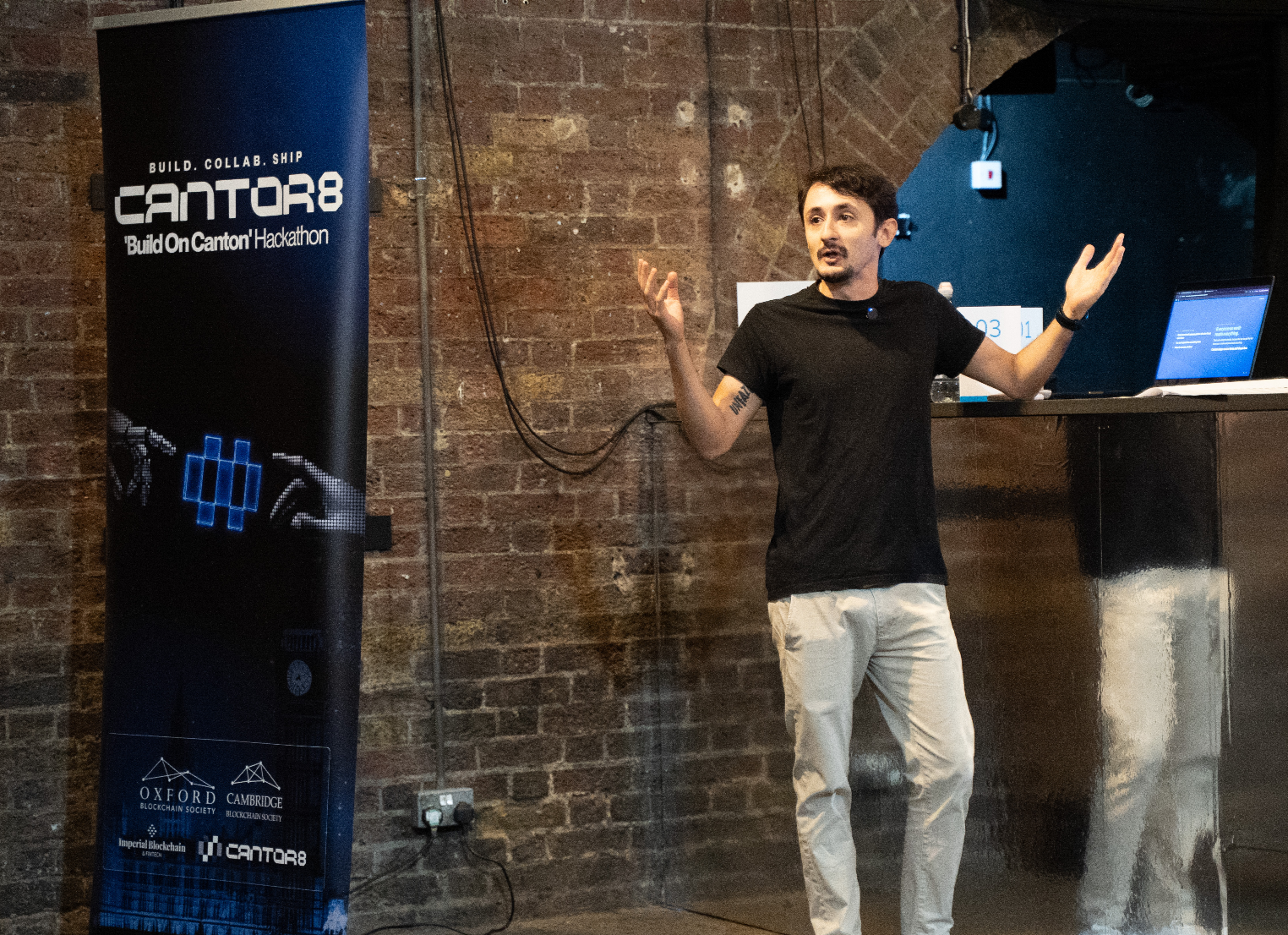
This decision was deliberate, as it is Canton Network’s unique architecture that makes it so suited to regulated and institutional use cases. This includes its compliant privacy architecture, network-of-networks structure and, of course, the Daml smart contract language itself - without which, none of these competitive advantages would be possible.
Once formed, competing teams were faced with their first significant decision - which of three distinct development tracks they should pursue…
(1) The Daml Track
By far the challenge requiring the most use of Canton Network’s native Daml smart contract language, Track 1 involved participants creating a highly functional wallet, purpose-built for use by AI agents operating on the network. It required the implementation of various restrictions, including spending limits.
(2) Canton Scanner
Track 2 involved participating teams architecting a dedicated Canton Network scanner which, using a pre-built API, could effectively index the ledger, and clearly serve balances and present transaction histories. Perhaps most importantly, the scanner needed to identify when a given dataset and the ledger itself disagreed or conflicted.
This task relied heavily on the use of Python, rather than Daml directly.
(3) No-Code Challenge
Though the least technical of the three tasks, Track 3 was no less challenging, requiring participants to research and articulate institutional use cases that only Canton Network can satisfy, rather than public blockchains like Ethereum.
Special Guests
The day’s agenda was scattered with guest appearances from leading voices within the Canton Network ecosystem, spanning developer talent from Digital Asset and Cantor8, through to the Head of The Canton Foundation itself.
Viv Diwakar - Head of The Canton Foundation
Viv is not only leading The Canton Foundation, but is himself a graduate of the prestigious Imperial College Business School.
Speaking to participants about the Canton ecosystem itself, its potential, and unique positioning, his exposure to and understanding of what makes the network special is unparalleled.
Robin Krom Ph.D - Head of R&D at Cantor8
Robin is perhaps the leading authority when it comes to Canton Network development and its native smart contract language. Now a core part of the Cantor8 team, he hails from Digital Asset (the development company behind Canton), where he built the Daml Compiler itself.
He spoke directly to participants about his journey into blockchain and Canton-focused development, as well as Canton’s own privacy model, alongside other means of secure encryption and data transfer.
Paola Shushkovsky - Head of BD & Marketing at Mugen
From the blockchain consulting powerhouse that is Mugen, BD & Marketing Head, Paola Shushkovsky brought her impressive suite experience in blockchain company operations and effective distribution to participants, ensuring participants received an educational angle beyond development itself.
Davide F - Senior Engineer at Cantor8
Present throughout the day at the event itself, Davide led all technical elements of the event itself, including briefing participants on the three available tracks, providing hands-on technical support, and leading the pitch session at the end of the day.
With deep development experience across Scala and Haskell, Davide’s has also spent time building on multiple blockchains outside of Canton (including public chains like Ethereum, Solana, and Cardano). This expertise was crucial in allowing him to guide participants at the event, most of whom were entirely new to Canton and Daml.

Judging Panel
Cantor8’s event team secured a phenomenal suite of hackathon judges, boasting experience both within and without the Canton Network ecosystem, and with special proficiency in areas ranging from development and cybersecurity through to blockchain economics and management.
- Canton Foundation Founding Chairman, Dr Jørgen Ouaknine.
- 7RIDGE C7 Managing Director, Sophia Grami.
- Alchemy Financial Services Engineering Lead, Flor Ronsmans de Vry.
- C7 Technology Lead, Leonid Rozenberg.
- Dedge Security Head of Strategic Growth & BD, Sarika Singh.
- Cantor8 CEO & Founder, Philip Kaddaj.
- Cantor8 Senior Engineer, Davide F.
Together, these judges formed the perfect body to assess hackathon entries from technical, security, institutional, commercial perspectives, and beyond.
The Winners
The event’s robust suite of judges were impressed by nearly every entry, leaving detailed feedback for all participating teams, but were especially compelled by four teams in particular, spanning multiple development tracks.
First Place: Team Mandate
Team Mandate was a favourite among judges for its careful consideration of AI agent capabilities, including limits on what they can spend, who with, and the ability to revoke its authority.
Second Place: Lattice Scan
The judges were especially complimentary about Lattice Scan’s exceptional diligence and precision in its implementation of a private index of Canton holdings and activity.
Third Place: Vorem
The judges awarded Vorem a podium position for its emphasis on security and smart application of restrictions and checks.
Fourth Place: DamnLE
DamnLE was repeatedly flagged by judges for its sound implementation and deep understanding of how policy interacts with business logic.
Honourable Mentions
Several teams that did not secure a winning position were nonetheless commended for compelling entries, and therefore made the official honours list. These projects received commendation prizes, despite not making the official winners list:
- Vectorasset
- Privity
- Agent Mandate
About Cantor8
Cantor8 is the leading financial infrastructure provider within the Canton Network ecosystem.
Founded by Cambridge academics and exited founder, Cantor8’s mission is to establish the single entry point for any institutional or regulated participant to access any blockchain use case, at any scale.
Practically, this means the ability to offer an end-to-end suite of infrastructure products which combine to satisfy any and all financial use cases. Already, Cantor8 offers robust and audited products spanning custody, issuance, trading, intelligence, and more besides, with several additional implementations currently in development and expected to launch within the year.
Cantor8’s solutions are already being implemented by some of the world’s largest financial institutions across the globe, including Korea’s largest financial holding company, KB Financial, and the telecommunications companies behind Africa’s $1.4 trillion mobile money economy.